High-Performance Dimmable LED Strips & Linear Systems
Verified OEM/ODM export configurations engineered for flicker-free dimming, ultra-high CRI 90+, and extended thermal lifespan.


Why Top Global Brands Partner with Shenzhen Vokud Technology
As an SGS on-site verified manufacturing leader in Shenzhen, we bridge the gap between complex architectural engineering specifications and mass volume OEM production.
SGS On-Site Verified Quality
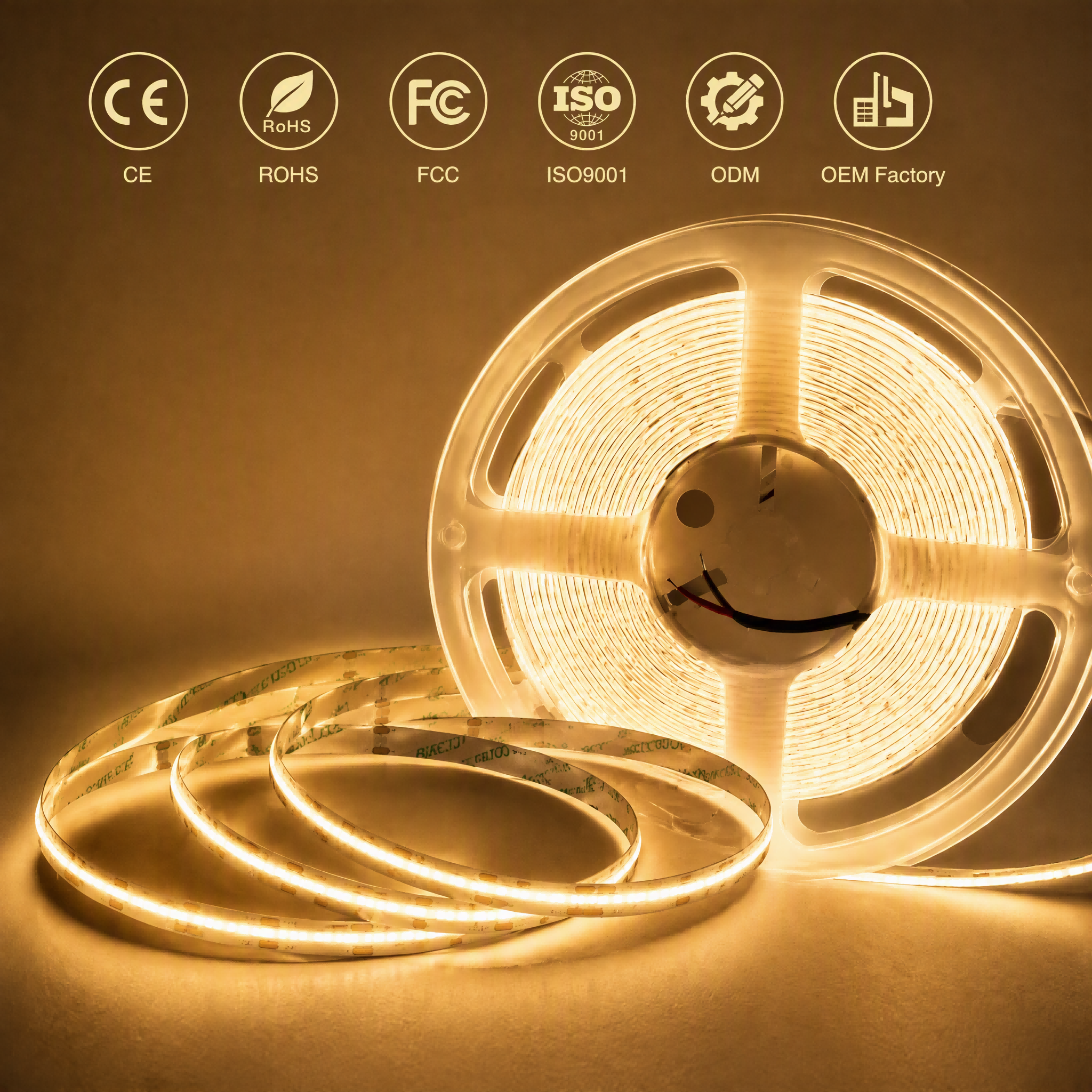
Our 10,000+ sqm manufacturing facilities undergo annual auditing by SGS Group. Every batch comes with full CE, RoHS, FCC, and EMC certification test compliance.
MacAdam 3-Step Bin Tolerance
We eliminate color shifts across production lots. Utilizing advanced spectroradiometers, our LED binning maintains strict SDCM < 3 for seamless visual uniformity.
Flicker-Free PWM & DALI Drivers
Engineered for high-frequency dimming (up to 40kHz) to prevent stroboscopic effects in broadcast environments, high-end hospitality, and smart buildings.
Custom Circuit & PCB Thickness
We supply 2oz and 3oz rolled copper PCBs to minimize voltage drop over long linear runs while enhancing thermal dispersion and mechanical durability.
Production Capability & Quality Metrics
Mastering Dimmable LED Strip Technologies: Protocols & Design Criteria
A technical guide for electrical engineers, lighting designers, and commercial procurement managers evaluating dimming efficiency and driver matching.
1. The Evolution of Dimming: Phase-Cut, 0-10V, DALI-2, and Digital PWM
Selecting the optimal dimmable LED strip requires a complete understanding of the control protocol chain. In traditional retrofits, Triac (Forward Phase) and ELV (Reverse Phase) dimming remain popular due to legacy wiring. However, high-end commercial projects demand digital protocols such as 0-10V/1-10V or DALI-2 (Digital Addressable Lighting Interface) to achieve smooth 0.1% dimming curves without audible noise or visible stepping.
At the LED strip level, dimming is primarily executed via Pulse Width Modulation (PWM) or direct constant-voltage amplitude modulation. High-quality dimmable COB and SMD strips rely on high-frequency PWM switching. When the PWM frequency exceeds 4,000 Hz, the human eye and camera sensors perceive continuous light, making high-frequency dimming essential for TV studios, luxury retail windows, and office environments.
| Dimming Protocol | Control Signal | Dimming Range | Flicker Risk | Primary Commercial Application |
|---|---|---|---|---|
| TRIAC / ELV | AC Mains Voltage Phase-Cut | 10% – 100% | Moderate at Low Levels | Residential Retrofits, Small Retail |
| 0-10V / 1-10V | DC Voltage Signal (0 to 10V) | 1% – 100% | Low (Driver Dependent) | Commercial Offices, Supermarkets |
| DALI-2 / D4i | Bi-Directional Digital Signal | 0.1% – 100% | Ultra-Low / Zero Flicker | Smart Buildings, Hotels, Luxury Architectural |
| PWM (Pulse Width) | High Frequency Switching | 0.1% – 100% | Zero (>3.8 kHz Frequency) | Broadcast Studios, Film Sets, COB Strips |
| Smart (Matter/Zigbee) | 2.4GHz Wireless Protocol | 1% – 100% | Depends on Sub-Driver PWM | Residential Smart Automation, IoT Spaces |
2. Solving Voltage Drop in Long-Run Dimmable Installations
One of the main challenges in linear LED tape procurement is voltage drop. As electrical current travels along a flexible printed circuit (FPC), trace resistance causes a voltage decrease, resulting in dimming unevenness—where the tail end of a 10-meter run appears noticeably dimmer than the feed end.
Engineering Solution: Shenzhen Vokud Technology utilizes 2oz/3oz heavy-copper double-sided PCBs combined with Integrated Constant Current (IC) IC drivers mounted directly on the strip. This ensures uniform power distribution up to 15 meters on a single 24V power feed, maintaining constant flux and identical dimming levels across the entire length.
3. COB (Chip-on-Board) vs. Traditional SMD Dimmable Strips
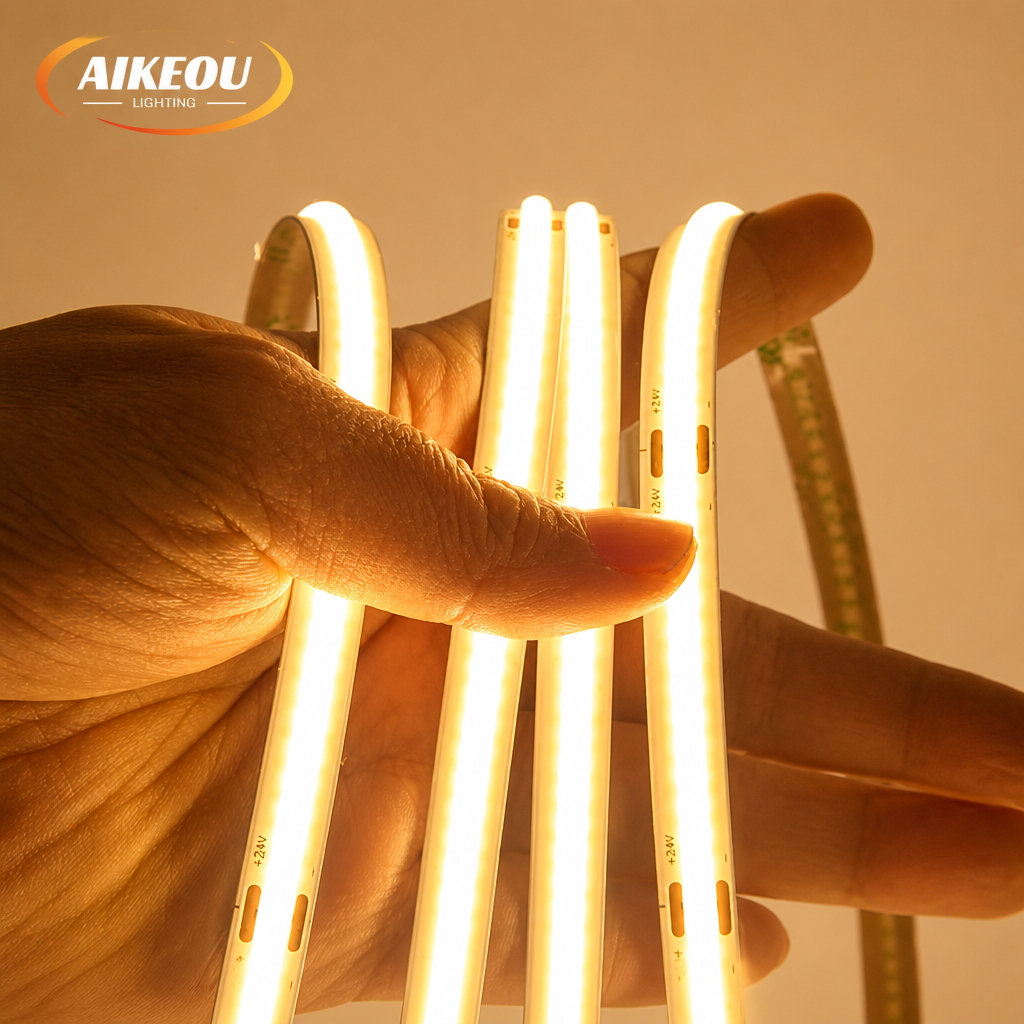
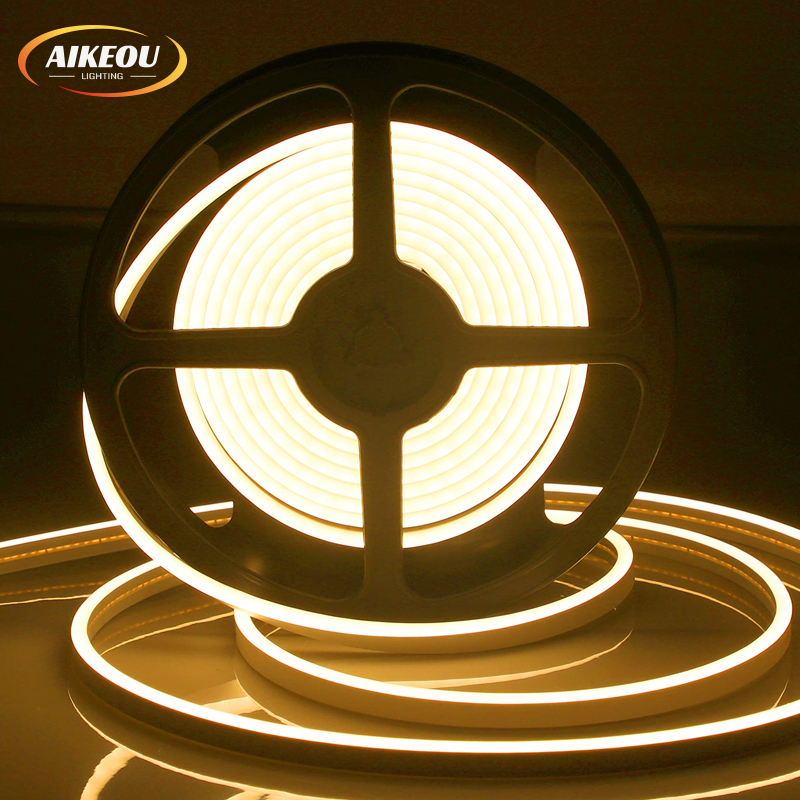
The market is shifting rapidly from conventional Surface Mount Devices (SMD2835, SMD5050) to Chip-on-Board (COB) architecture. COB technology packages bare LED dies directly onto the FPC, covered by a continuous phosphor gel layer.
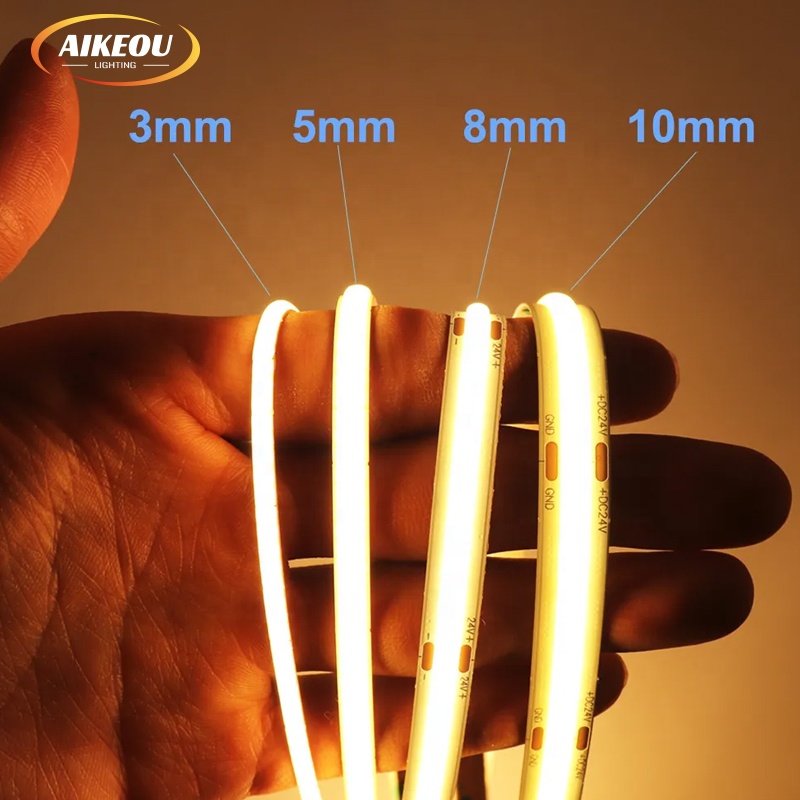
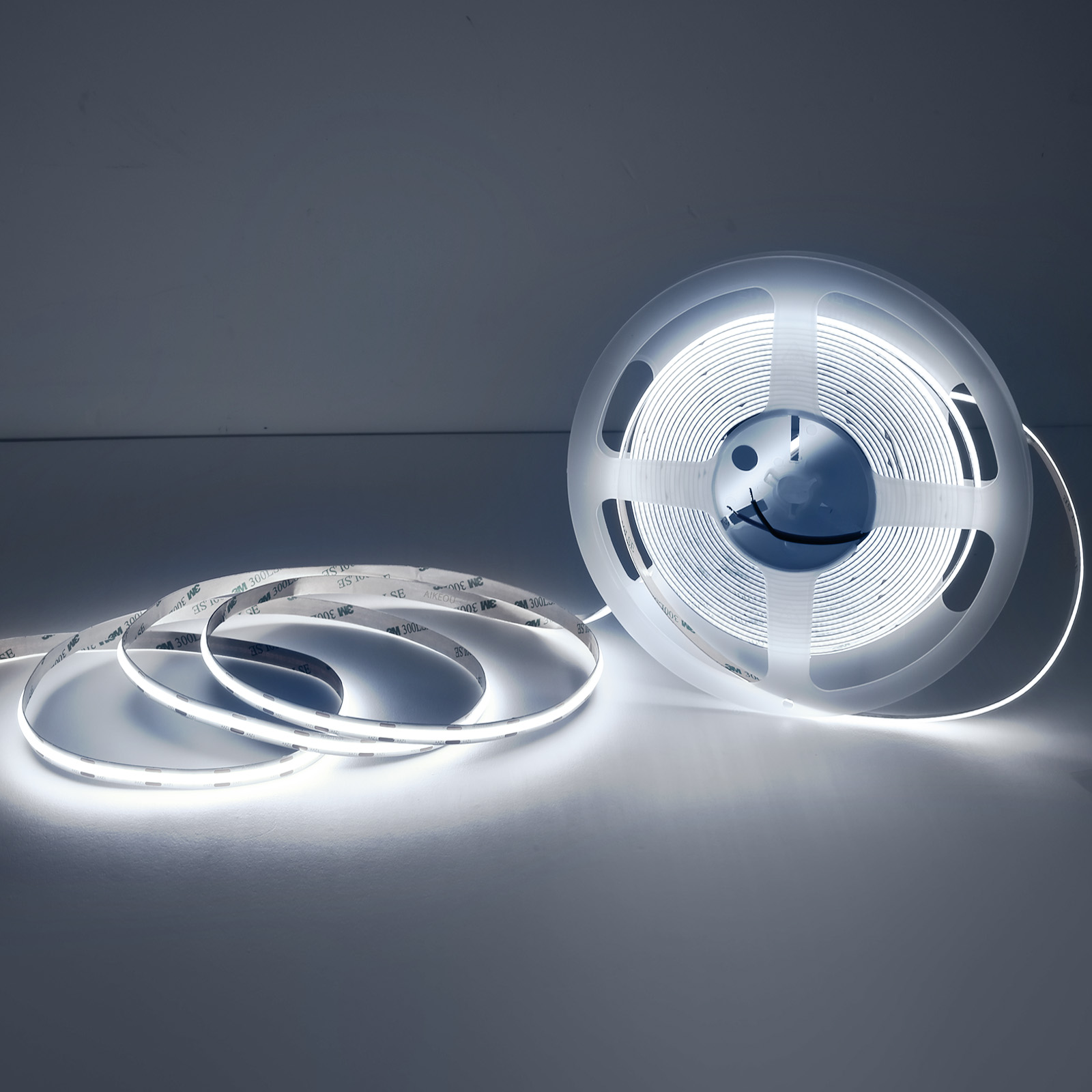
With chip densities reaching 320 to 528 LEDs per meter, COB strips create a completely continuous, dotless beam of light. When dimming COB strips, the continuous phosphor layer prevents the "pin-point glare" commonly seen when dimming low-density SMD strips, offering superior performance in shallow aluminum channels and handle-less cabinet extrusions.
Future Sourcing Trends in Dimmable LED Strip Technology
How global purchasing managers and OEM buyers can stay ahead of energy regulations, IoT integration, and technological shifts.
1. Higher Luminous Efficacy (>160 lm/W)
Driven by EU ERP energy ratings and Title 24 compliance in California, future dimmable strips must deliver maximum lumen output at lower wattages. Advanced flip-chip COB configurations reduce thermal resistance, allowing higher current drive with less heat generation.
2. Universal Smart IoT Connectivity (Matter Standard)
Proprietary wireless dimmers are being replaced by unified smart home ecosystems. Sourcing dimmable strips compatible with Matter-over-Thread and Zigbee 3.0 control modules guarantees seamless interoperability across Apple HomeKit, Google Home, and Alexa platforms.
3. Dynamic Spectrum & Tunable White (CCT)
Human-Centric Lighting (HCL) requires smooth color temperature transitions from 2700K (relaxing warm white) to 6500K (energizing daylight). Dual-channel dimmable CCT COB strips are fast becoming the default standard for modern office and healthcare projects.
4. Co-Extruded Silicone (IP68 Waterproofing)
Traditional PVC casing degrades and yellows under UV exposure. Modern outdoor dimmable strips utilize integrated silicone co-extrusion, achieving IP68 ingress protection, resistance to saline environments, and stability in extreme thermal conditions (-40°C to +60°C).
Custom OEM/ODM Manufacturing Workflow
From initial spectral engineering to final export packaging, our 8-step quality assurance framework guarantees strict specification compliance.
Brief & Photometrics
Review target lumens, CCT range, CRI requirements, voltage constraints, and dimming protocol requirements.
PCB Layout & Circuitry
CAD design of 2oz/3oz FPC boards with optimized trace routing to prevent thermal bottlenecks and voltage drop.
Sample Prototyping
Solder mask printing, high-speed SMT chip placement, and continuous phosphor dispensing for COB strips.
Spectroradiometer Audit
Testing initial color coordinates, flux output, R9 red values, and SDCM color consistency inside integrating spheres.
Golden Sample Approval
Sealing the verified golden sample for client sign-off before initiating full-scale automated production.
Automated SMT & Assembly
High-capacity SMT lines mount bare dies and resistors, followed by continuous automated phosphor curing ovens.
100% Burn-In & Aging
Every meter undergoes continuous 8-hour high-voltage burn-in testing to catch early component dropouts.
Anti-Static Export Packaging
Vacuum sealing in moisture-barrier reels with custom OEM labels, reel length marking, and outer carton drop testing.
Frequently Asked Questions for B2B Importers & Wholesalers
Essential technical and commercial answers to help streamline your sourcing process from China.
What is the minimum order quantity (MOQ) for custom dimmable LED strips? +
How do you eliminate dimming flicker when paired with third-party drivers? +
What certifications can you provide for customs clearance and retail distribution? +
How should I choose between 12V, 24V, and 48V low-voltage dimmable strips? +
24V DC is the industry standard for architectural linear lighting, supporting runs up to 10 meters from a single power feed while cutting current in half compared to 12V.
48V DC is recommended for extended continuous linear runs (up to 20 meters without voltage drop) in large office spaces, retail aisles, and hotel corridors.
Can you support full OEM private label packaging and custom reel printing? +
How does your quality control lab verify color consistency (SDCM)? +
Partner with a Trusted Dimmable LED Strip Manufacturer
Need custom PCB design, high-CRI COB samples, or factory-direct pricing for your next tender? Speak directly with our senior lighting engineers.
