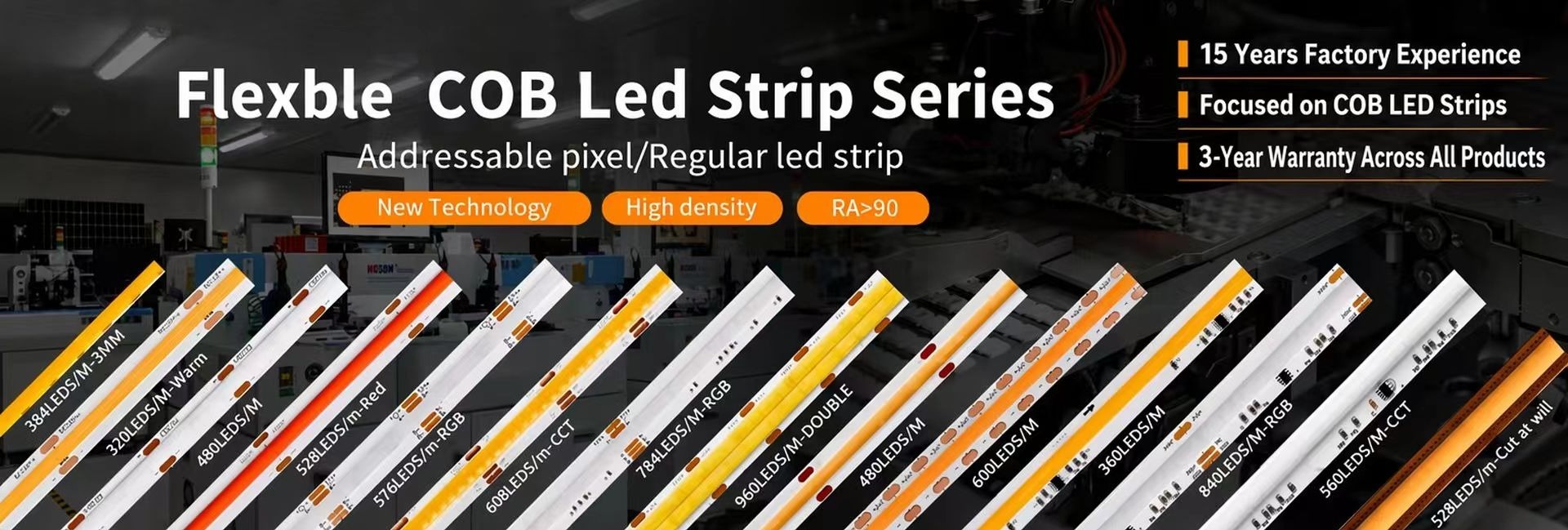
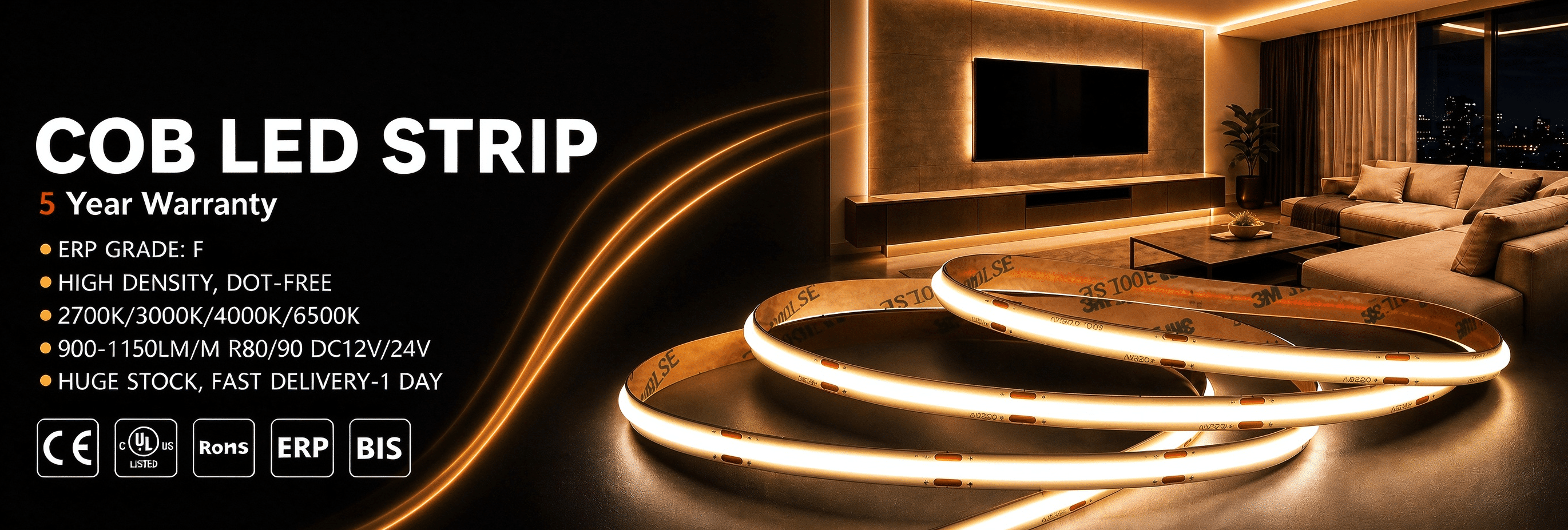
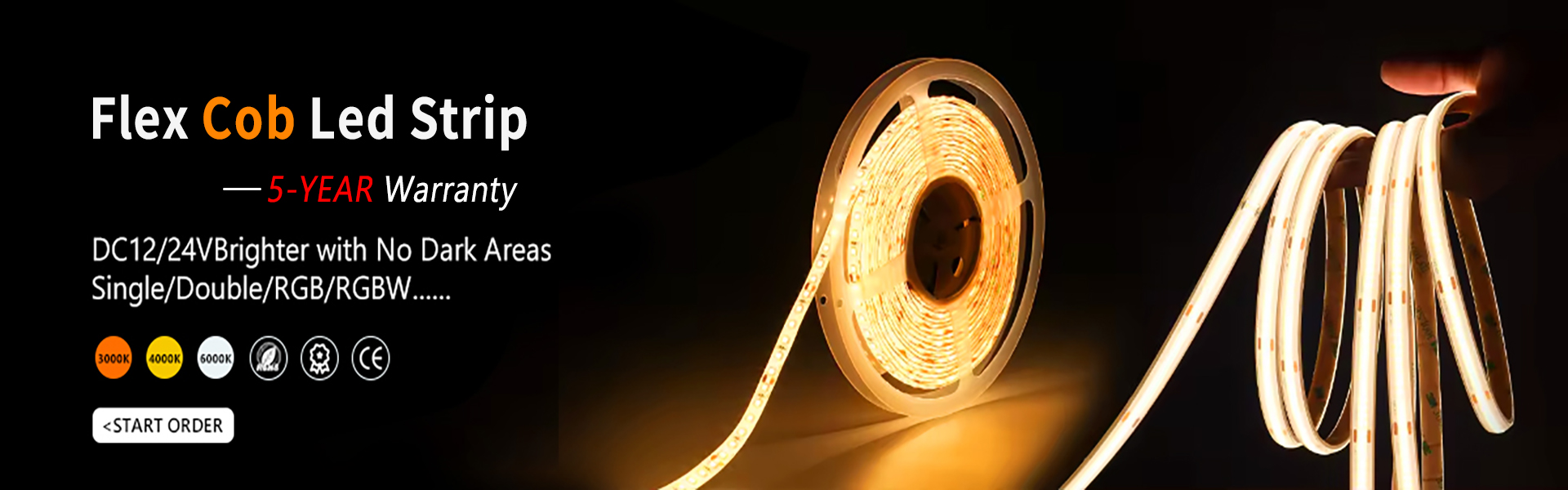
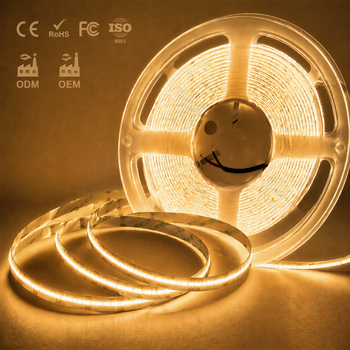
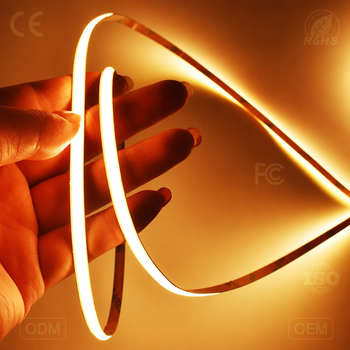
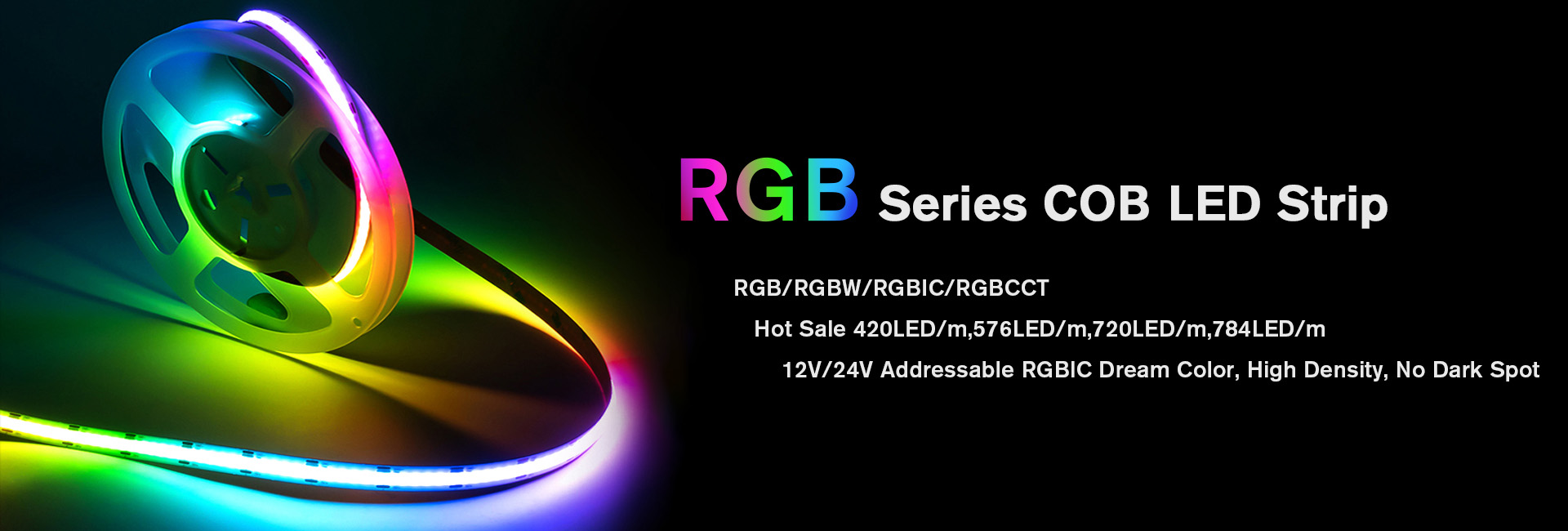
In modern architectural and commercial lighting design, Chip-on-Board (COB) technology has transformed linear strip lighting. Unlike traditional Surface Mounted Device (SMD) strips—which place discrete packaged diodes (e.g., SMD 2835 or 5050) spaced millimeters apart—the 12V 24V COB LED strip mounts bare flip-chips directly onto a flexible printed circuit (FPC). Encapsulated under a continuous, yellow phosphor silicone layer, COB strips feature 320 to 576 chips per meter. This high diode density eliminates visible light dots, hot spots, and shadow gaps, producing a flawless, homogeneous ribbon of light even inside ultra-shallow aluminum channels.
However, when selecting between a 12V COB LED strip and a 24V COB LED strip, commercial procurement managers and lighting engineers must evaluate three fundamental electrical parameters: current density (Amperes), resistance loss ($I^2R$ power drop), and thermal management.
1. Electrical Physics: Current Draw and Voltage Drop Mitigation
According to Ohm’s Law ($P = V \times I$), operating a 14.4 Watt/meter COB LED strip at 12 Volts requires a current draw of $1.2\text{ A/m}$. The same 14.4 W/m tape operating at 24 Volts draws only $0.6\text{ A/m}$. Because Joule heating (power loss dissipated as heat along the copper traces) is proportional to the square of the current ($P_{loss} = I^2 \times R$), halving the operating current reduces trace heat losses by 75%.
This electrical dynamic translates directly into practical installation length:
- 12V COB LED Strip: Ideal for short, precision runs under 5 meters (16.4 ft), such as cabinet under-lighting, display cases, automotive interiors, and custom furniture channels. Beyond 5 meters powered from a single feed, cumulative copper resistance causes noticeable voltage drop, resulting in visible dimming at the far end of the strip.
- 24V COB LED Strip: The industry standard for commercial architectural installations, coves, long hallway recessed profiles, and perimeter lighting. A 24V COB LED strip can maintain uniform lumen output across single-feed continuous runs of 10 meters (32.8 ft) or longer, reducing driver count, wiring complexity, and labor costs during site installation.
2. Thermal Dissipation and PCB Copper Weight Engineering
Because COB LED strips mount up to 576 chips per meter in extreme proximity, thermal management is paramount. Excessive heat buildup accelerates lumen depreciation, causes color shift (CCT drift), and degrades the silicone phosphor layer over time. At Shenzhen Vokud Technology Co., Ltd., our engineering team solves thermal stress through advanced FPC material design:
- 3oz Double-Sided Rolled Copper FPC: Instead of cheap single-layer 1oz copper circuit boards, Vokud uses heavy double-sided 2oz and 3oz rolled copper FPCs. This increased copper thickness acts as a built-in heat spreader, rapidly conducting heat away from the bare flip-chips.
- High Thermal Conductive Adhesive: Every reel of Vokud 12V 24V COB LED strip is backed with authentic 3M thermal adhesive tape (such as 3M 300LSE or 200MP), establishing intimate thermal contact with the aluminum profile extrusion for rapid heat sinking.
- Flip-Chip Bonding Technology: Flip-chips eliminate delicate gold wire bonds, improving thermal resistance by bonding the die's P-N junction directly to the FPC copper pads via solder bumps.