High-Performance Constant Voltage & COB LED Strips
Direct from our SGS-verified Shenzhen manufacturing center. Engineered for rigorous architectural integration, color consistency, and long-term thermal stability.



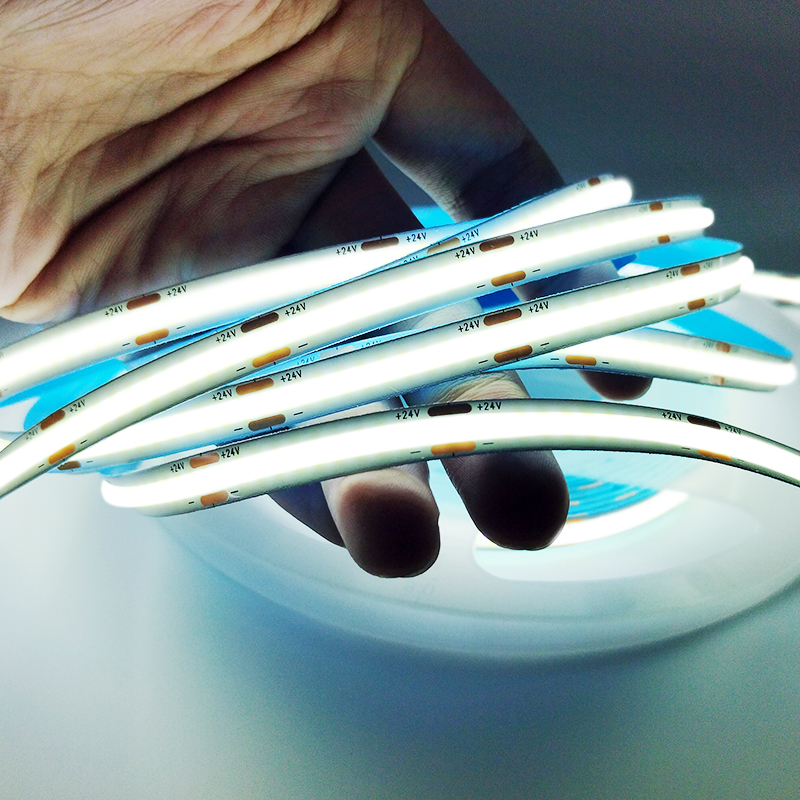
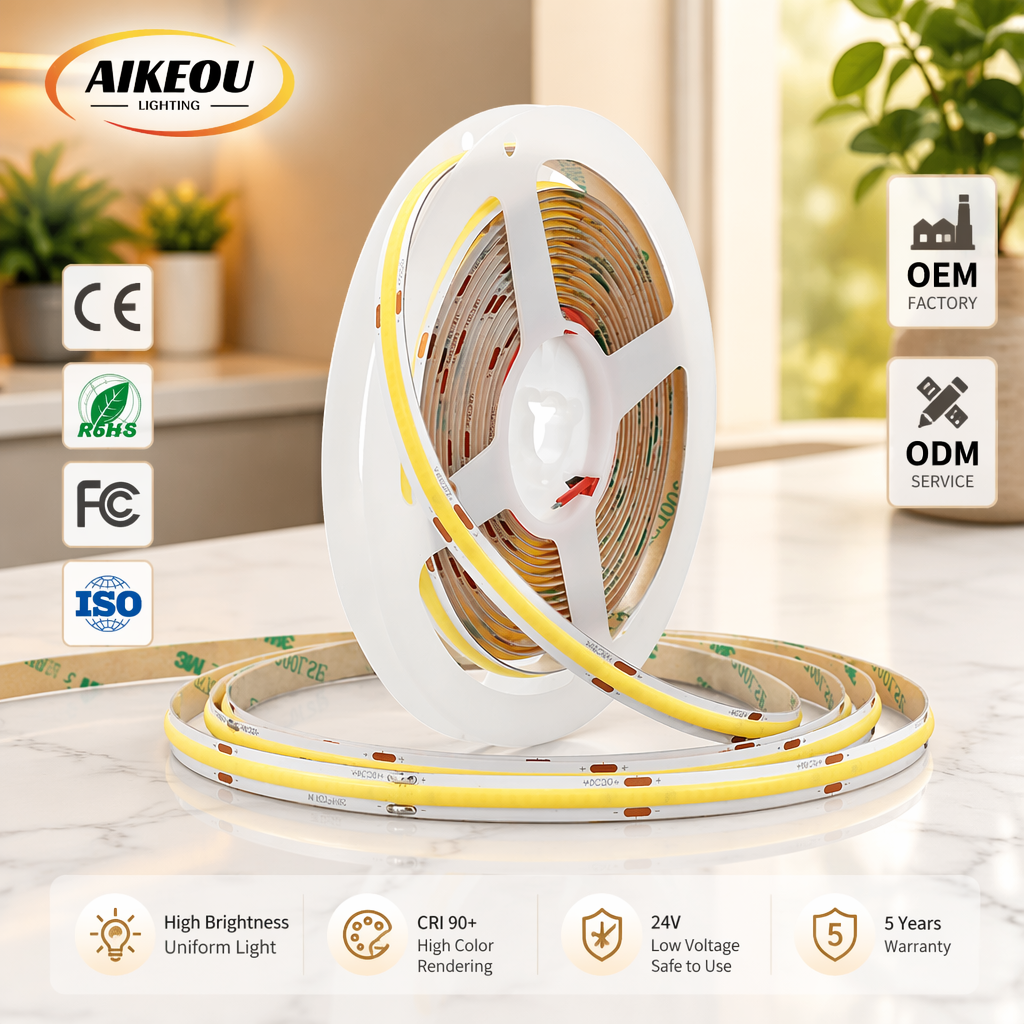

Engineering Overview: Constant Voltage (CV) LED Strip Systems
Understanding the electrical parameters, thermal dynamics, and circuit topologies that dictate long-term performance in commercial and architectural linear lighting.
Constant Voltage (CV) Circuit Fundamentals
Constant Voltage (CV) LED strips operate on a fixed direct-current rail—most commonly DC 12V, 24V, or 48V. In a CV architecture, LED chips are arranged in parallel groupings (cuttable segments) consisting of a series combination of bare LED dies or SMD packages along with current-limiting surface-mount resistors or linear driver ICs. This topology allows the overall flex tape to be trimmed to length on site at designated copper pad cut lines without altering the electrical operating parameters of remaining segments.
When evaluating a premier Constant Voltage LED Strip Supplier, procurement managers must analyze the copper weight of the flexible printed circuit board (FPC). High-tier manufacturers utilize 2oz (70µm) or 3oz (105µm) rolled-annealed copper tracks. Thick copper minimizes I²R resistive power losses, mitigates voltage drop across extended runs, and ensures even illuminance from power feed point to distal end.
Voltage Drop Engineering & Formulaic Calculation
Voltage drop ($\Delta V$) remains the central physical constraint in low-voltage linear LED deployment. As current ($I$) passes through copper traces, internal resistance ($R$) produces an incremental drop in potential according to Ohm's Law ($\Delta V = I \times R$). This manifests visually as thermal accumulation near the driver and dimming towards the strip tail.
Selecting 24V DC or 48V DC Constant Voltage LED strips over legacy 12V systems slashes operational current by 50% and 75% respectively for equivalent wattage ($P = V \times I$). Because power loss in traces scales quadratically with current ($P_{loss} = I^2 R$), transitioning from 12V to 24V reduces trace power dissipation by 75%, allowing continuous single-feed runs up to 10 meters without perceptible lumen depreciation.
| Architecture Parameter | DC 12V Constant Voltage | DC 24V Constant Voltage | DC 48V Constant Voltage | Constant Current (CC) Strips |
|---|---|---|---|---|
| Max Single-Feed Length | 5 Meters (16.4 ft) | 10 Meters (32.8 ft) | 15–20 Meters (65 ft) | 20–50 Meters (164 ft) |
| Trace Current Density | High ($I = P/12$) | Medium ($I = P/24$) | Low ($I = P/48$) | Ultra-Low / Regulated IC |
| Cut Segment Pitch | Short (e.g., 25mm / 3 LEDs) | Medium (e.g., 50mm / 6 LEDs) | Longer (e.g., 100mm / 12 LEDs) | Fixed IC Segment Units |
| Driver / Power Compatibility | Universal 12V CV Drivers | Universal 24V CV Drivers | Commercial 48V CV Drivers | Specialized CC Power Supplies |
| Optimal B2B Application | Short cabinet runs & automotive | Commercial, retail & residential | Long architectural coves & façades | Industrial long-run perimeter lines |
Constant Voltage LED Strip Procurement & Specification Matrix
A rigorous decision-making model for lighting designers, electrical contractors, and OEM brand buyers.
1. Photometric Yield & High CRI Metrics
For high-end commercial hospitality and retail, raw lumen output must be balanced with Color Rendering Index (CRI/Ra) and Color Fidelity (TM-30-18). Top-tier suppliers deliver CRI > 90 / CRI > 95 with R9 values exceeding 80, preventing color shift in textiles, artwork, and human skin tones. Ensure chip binning follows 3-Step MacAdam Ellipse (SDCM < 3) across all production batches.
2. Linear Density: COB vs. High-SMD
Traditional SMD strips (e.g., 60 to 120 LEDs/m) require deep aluminum profiles with frosted diffusers to eliminate dark spots. Modern Chip-on-Board (COB) Constant Voltage strips feature 320 to 720 micro-chips encapsulated beneath a continuous phosphor silicone line, producing a 100% dotless, homogeneous ribbon of light even when mounted in shallow 5mm millwork profiles.
3. Ingress Protection (IP) & Encapsulation
Match environmental requirements with exact IP grades:
- IP20: Bare FPC for dry indoor channels.
- IP65: Nano-silicone coat for splash-zone cove lighting.
- IP67: Hollow silicone tube extrusion for damp outdoor accenting.
- IP68: Integrated solid silicone co-extrusion for underwater immersion & saunas.
Future Sourcing & Procurement Trends in LED Strip Manufacturing (2025–2030)
Key technological, regulatory, and supply chain shifts shaping global B2B procurement over the next five years.
Trend 1: Migration to DC 48V Low-Voltage Infrastructure
As commercial spaces favor uninterrupted linear cove lighting spanning tens of meters, procurement teams are rapidly pivoting from 12V and 24V to 48V Constant Voltage LED ecosystems. 48V systems comply with Class 2 extra-low voltage (SELV) safety standards while quadrupling run lengths from a single power feed, dramatically reducing electrical box counts, wiring labor, and driver installation costs.
Trend 2: Full Integration with Matter & DALI-2 DT8 Controllers
Constant Voltage linear strips are evolving into active nodes within smart building management networks (BMS). OEM buyers are mandating native driver compatibility with DALI-2 DT8 (Tunable White), Zigbee 3.0, and Matter-over-Thread protocols. Pulse-Width Modulation (PWM) dimming frequencies are shifting above 4,000Hz to 10,000Hz to satisfy flicker-free IEEE 1789-2015 standards required for high-definition video recording and ergonomic workspace compliance.
Trend 3: Chip-Scale Package (CSP) & Micro-COB Convergence
Legacy surface-mount devices (SMD 2835, 5050) are losing market share to CSP and COB technologies. CSP eliminates wire bonding and lead frames, attaching flip-chip die directly to the copper FPC. This yields superior heat dissipation, a wider 180° beam angle, higher mechanical flexibility under tight bending radii, and significantly lower warranty failure rates.
Trend 4: Ecodesign & Circular Supply Chain Compliance
Regulatory frameworks such as the European Union’s ErP (Ecodesign Directive 2019/2020) and mandatory RoHS 3 / REACH certifications require suppliers to verify luminous efficacy levels exceeding 140 lm/W to 180 lm/W for Constant Voltage systems. Leading factories are introducing halogen-free FPCs, lead-free low-temperature solder pastes, and fully recyclable reel packaging to meet corporate ESG benchmarks.
Next-Generation Product Innovations in Linear Lighting
How cutting-edge engineering is solving architectural challenges and opening new commercial applications.
Miniaturization & Ultra-Narrow FPCs
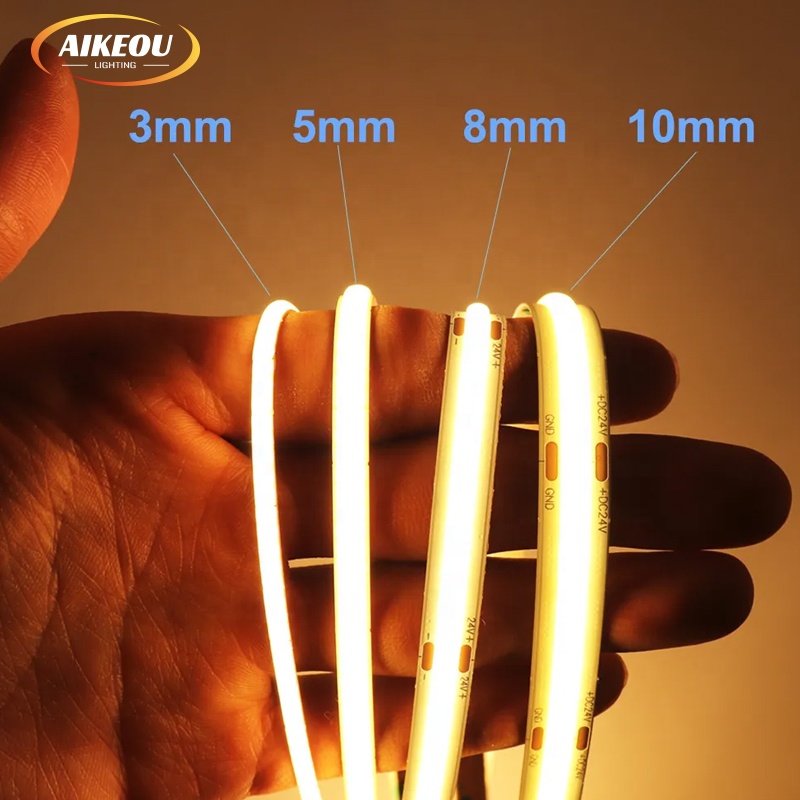
Architectural millwork and showcase lighting demand sub-miniature light channels. Product lines now feature 2.7mm, 3mm, and 5mm ultra-narrow COB strips with micro cut-points every 5mm to 10mm. These ultra-thin formats fit inside micro-recessed extrusions without visible edge shadow.
Human-Centric Tunable White (CCT)
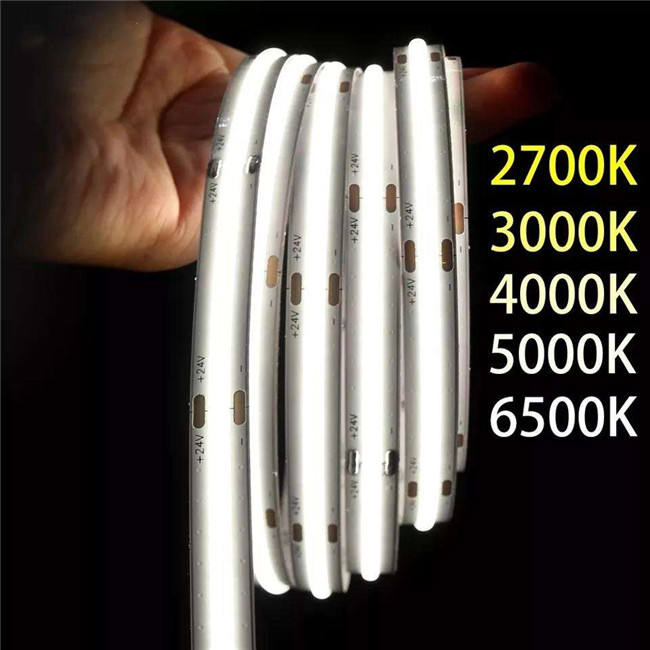
Circadian rhythm lighting utilizes dynamic dual-color Constant Voltage channels (2700K to 6500K). Advanced mixing algorithms allow smooth color temperature transitions that mimic natural daylight cycles, driving adoption in healthcare facilities, corporate offices, and luxury residences.
Addressable RGBIC & Digital Dynamic Flow
Incorporating embedded integrated circuits (such as WS2811, UCS1903, or SK6812) onto Constant Voltage FPCs enables individual pixel addressability. This facilitates dynamic chasing effects, hospitality accenting, and sound-reactive entertainment installations while operating on standard 12V or 24V bus lines.
OEM/ODM Manufacturing Capabilities: Shenzhen Vokud Technology
A trusted manufacturing partner verified on-site by SGS Group, dedicated to delivering uncompromised quality for global lighting brands.
Automated High-Speed SMT & Dispensing Lines
Our Shenzhen factory utilizes state-of-the-art high-speed Yamaha and Fuji Surface Mount Technology (SMT) lines capable of mounting hundreds of thousands of bare chips per hour with micrometer-level placement precision. Automated optical inspection (AOI) equipment verifies solder joint integrity across 100% of production runs, ensuring zero cold-solder defects or open circuits.
SGS-Verified Quality Management & Testing Lab
Verified on-site by SGS Group, our facility operates 9 specialized photometric and environmental testing instruments. Every production lot undergoes spectrometer integrating sphere measurements, goniophotometer lumen validation, thermal shock chamber testing, high-humidity IPX8 immersion trials, and continuous 4-hour burn-in aging prior to vacuum anti-static export packaging.
Constant Voltage LED Strip Procurement FAQ
Detailed engineering answers to critical purchasing, installation, and quality control inquiries.
How do I mitigate voltage drop across long-run Constant Voltage installations?
Voltage drop can be mitigated by: (1) Selecting 24V DC or 48V DC strips instead of 12V DC; (2) Utilizing 2oz or 3oz heavy-copper FPCs; (3) Implementing a dual-ended power feed (connecting power supplies to both ends of the strip); or (4) Running parallel heavy-gauge main DC bus wires alongside the profile and tapping into the strip every 5 to 10 meters.
What is the recommended power supply derating rule for Constant Voltage systems?
Electrical engineering standards mandate an 80% continuous load rule. To ensure long-term power supply reliability and prevent thermal shutdown, calculate total system wattage (Wattage per meter $\times$ Total meters) and select a driver rated for at least 125% of that load. For example, a 100W total LED strip load requires a minimum 125W rated Constant Voltage DC driver.
Why is MacAdam Ellipse binning critical when sourcing from a Constant Voltage LED Strip Supplier?
MacAdam Ellipse binning dictates color consistency between manufacturing batches. Standard commercial grade lighting often uses 5-Step MacAdam binning, which results in noticeable color variations between adjacent reels. Premium architectural suppliers enforce 3-Step MacAdam Ellipse (SDCM < 3), guaranteeing that replacement reels or multi-strip wall coves display identical color temperature and chromaticity coordinates.
What are the primary structural differences between COB and traditional SMD strips?
Traditional SMD strips surface-mount discrete plastic LED packages (e.g., SMD 2835) onto the FPC at spaced intervals, producing concentrated light hotspots. COB (Chip-on-Board) strips mount bare LED flip-chips directly onto the copper FPC in ultra-high density (320 to 720 chips/m) and cover them with a continuous phosphor silicone strip. This creates a uniform line of light with no dark spots, a wider 180° beam angle, and superior bending flexibility.
What custom OEM/ODM parameters can your factory accommodate for bulk orders?
As a direct custom manufacturer, we accommodate custom FPC widths (from 2.7mm to 15mm), customized PCB copper thickness (1oz to 3oz), custom CCT binning (2200K to 6500K, amber, red, green, blue, pink), custom cut-segment lengths, private label branding on anti-static bags and reels, custom lead wire harness soldering, and custom retail packaging boxes.
Which certifications are provided for customs clearance in Europe and North America?
All our Constant Voltage and COB strip series are fully certified with CE (LVD & EMC), RoHS 3, FCC, and Declaration of Conformity (DoC). Test reports and photobiological safety documents (IEC/EN 62471) can be dispatched directly to your compliance team for import verification.
Partner with a Leading Constant Voltage LED Strip Supplier
Request technical datasheets, photometrical IES files, customized sample reels, or factory direct OEM quotes. Our senior optical engineers are standing by to assist with your project layout.
